A practical guide on working with a WordPress freelancer for agencies: phases, deliverables, and real evaluation criteria to make every project succeed.
What It Really Means to Work with a WordPress Freelancer for Agencies
When a digital agency brings a WordPress freelancer for agencies into its workflow, the reality looks quite different from what most people expect. It’s not simply a matter of “send a brief, receive a finished website.” A professional collaboration between an agency and an external WordPress developer involves defined phases, structured communication, and shared quality standards.
Table of Contents
- What It Really Means to Work with a WordPress Freelancer for Agencies
- Phase 1: The Initial Fit — Beyond the Budget
- Phase 2: Defining Scope and Deliverables
- Phase 3: Development — How Execution Actually Works
- Quality Indicators to Monitor During the Project
- Common Mistakes in Agency–Freelancer Collaboration
- How to Evaluate a WordPress Freelancer Before You Hire
- The Handoff: What a Finished Project Should Include
- Frequently Asked Questions
This article breaks down how that process works in practice — from the first contact to the final handoff — covering the most common friction points and the indicators that tell you whether the collaboration is actually on track. This isn’t a theoretical guide; it’s grounded in real working dynamics between agencies and specialized freelance WordPress developers.
Phase 1: The Initial Fit — Beyond the Budget
The first mistake many agencies make is evaluating a freelance WordPress developer purely on rate. The initial fit has three dimensions that matter more than an hourly price:
Technical compatibility: Does the freelancer work with the same stacks your agency needs? A project built with Elementor is a very different beast from one using native Gutenberg blocks or a custom theme built from scratch. A developer who excels at ACF and custom development may not be the right fit for a page-builder layout project — and vice versa.
Operational compatibility: How do they manage tasks? Do they work with tools like Asana, ClickUp, or Basecamp? Are they willing to communicate through your agency’s preferred channels, or do they insist on their own? Operational friction kills more collaborations than a lack of technical talent.
White-label compatibility: Many agencies need the developer to remain invisible to the end client. That means the freelancer doesn’t sign the work, doesn’t contact the client directly, and respects the agency’s brand identity in all communications. This must be agreed upon in writing before any work begins.
Phase 2: Defining Scope and Deliverables
This is where most collaborations go sideways. An ambiguous brief produces ambiguous results. A professional WordPress freelancer for agencies should request — or even insist on — certain elements before committing to a deadline:
Finalized designs: Figma, Sketch, or Adobe XD files covering every page, every state (hover, active, error), and all responsive breakpoints. When an agency delivers “desktop only” and expects the freelancer to “figure out” mobile, the result almost always means extra revision rounds.
Functional specification: A clear list of what the site must do — contact forms, filtering systems, third-party integrations, conditional logic in WooCommerce, custom fields for specific content types. Every undocumented feature is a feature that will surface as “this is missing” during the review.
Real content: Copy, images, videos. According to HubSpot, missing real content is the leading cause of delays in web projects. Building with Lorem Ipsum creates layout issues that only become visible once the actual content arrives.
The Scope Document as a Safety Net
A skilled WordPress freelancer for agencies writes (or co-writes) a scope document that covers: pages to be developed, specific features, technologies to be used, number of included revision rounds, estimated timeline, and the conditions under which scope changes trigger additional cost. This document isn’t bureaucracy — it’s the single tool that prevents roughly 80% of project conflicts.
Phase 3: Development — How Execution Actually Works
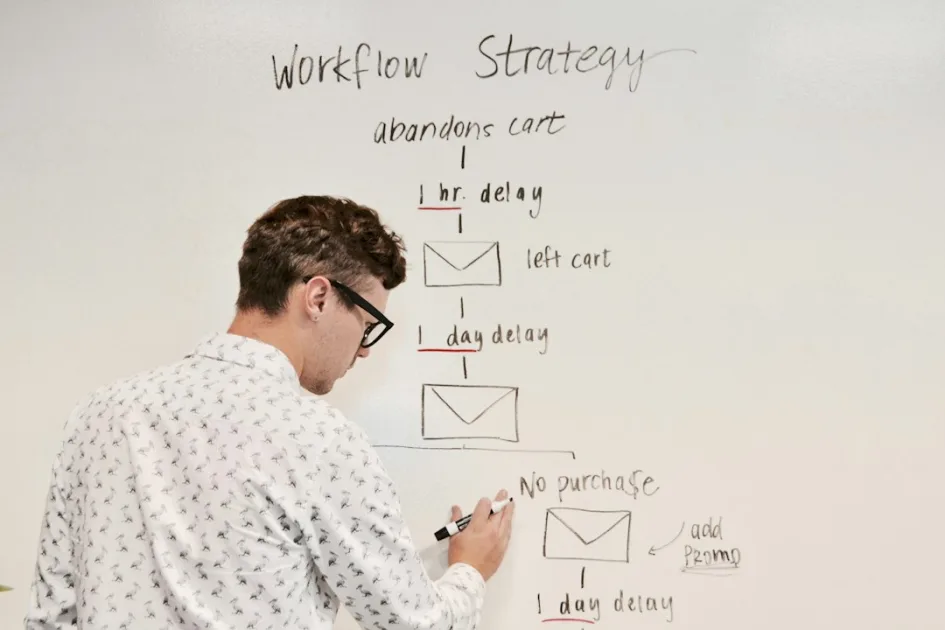
The development phase varies the most from one freelancer to the next. Some deliver everything at once at the very end; others work in incremental releases. For agencies, the incremental model almost always works better because it lets you catch deviations before they become expensive.
A typical professional execution flow looks like this:
Sprint 1 (Days 1–5): Development environment setup (staging), base WordPress installation, configuration of the base or custom theme, navigation structure, and main page templates. The agency should be able to see a functional staging environment by the end of this phase.
Sprint 2 (Days 6–12): Development of interior pages, implementation of custom fields (ACF, Meta Box, or similar), reusable component development, form setup, and custom JavaScript functionality.
Sprint 3 (Days 13–18): Third-party integrations (CRM, email marketing, payment gateways for WooCommerce), performance optimization, cross-browser testing, and responsive QA on real devices.
Sprint 4 (Days 19–22): Agency review round, final adjustments, technical documentation, and preparation for migration to production.
These timelines are benchmarks for a medium-complexity project (10–15 pages with custom features). WooCommerce projects with large catalogs or complex business logic can easily take twice as long.
Quality Indicators to Monitor During the Project
You don’t have to wait for the final delivery to know whether a freelance WordPress developer is doing solid work. Here are measurable indicators an agency can check throughout the build:
Accessible, up-to-date staging environment: If the freelancer doesn’t provide access to a staging environment where the agency can track progress in real time, that’s a red flag. Staging is the project dashboard — without it, the agency is flying blind.
Version-controlled code: A professional developer uses Git for version control. This makes it possible to track changes, roll back errors, and — if the agency ever needs to switch developers — ensure a smooth handover. Asking “Do you use a Git repository?” during the initial vetting conversation is entirely reasonable.
Staging load times: If the staging site takes more than four seconds to load without real content, the problem will only get worse in production. A competent freelancer optimizes from the start, not as an afterthought at the end.
Real responsive testing: “Looks fine when I resize the Chrome window” isn’t enough. Testing on actual mobile devices — or at minimum using tools like BrowserStack — is part of a proper quality process.
Common Mistakes in Agency–Freelancer Collaboration
After years of observing and participating in this type of collaboration, these are the mistakes that come up most consistently:
Failing to Define Hosting Ownership and Access Credentials
Who’s paying for hosting? Who holds the domain credentials? Who is the primary WordPress administrator? These “administrative” details create very real blockers when they aren’t sorted out upfront. The professional standard is that the agency (or its end client) always owns all access credentials, with the freelancer working under delegated permissions that can be revoked after delivery.
Confusing “Revisions” with “Scope Changes”
A revision is: “The button should be dark blue, not light blue.” A scope change is: “We need to add a booking system that wasn’t in the brief.” Conflating the two leads to mutual frustration. A professional freelancer specifies how many revision rounds are included and clearly defines what constitutes a scope change that requires additional budget.
Delivering Without Documentation
A WordPress project delivered without documentation is a time bomb. Minimum documentation should cover: access credentials, installed plugins and their purpose, custom fields created, content editing instructions, and technical dependencies (required PHP version, plugins that must not be deactivated). Without this, any future change — whether by the agency or another developer — starts from zero.
How to Evaluate a WordPress Freelancer for Agencies Before You Hire
Beyond the portfolio (which matters but isn’t enough), there are specific questions that reveal the real caliber of a WordPress freelancer for agencies:
“Can I see the code from a previous project?” A freelancer who writes clean code has no issue sharing a sample. If everything they’ve built uses page builders without a single line of custom code, their profile may not be the right match for projects that require bespoke development.
“How do you handle last-minute changes?” The answer reveals professional maturity. “No problem, I just do them” sounds accommodating but usually signals a lack of scope control. “I document the request, assess its impact on timeline and budget, and execute after approval” is the answer of someone who has managed real projects.
“What happens if I need support after delivery?” Some freelancers offer a warranty period (typically 30 days for bugs). Others consider the relationship closed once the project is handed off. Neither model is inherently better, but the agency needs to know which one it’s signing up for.
“Do you work under NDA?” For white-label engagements, a non-disclosure agreement should be standard practice. If a freelancer pushes back on signing one, that may signal they aren’t accustomed to working under another company’s brand.
The Handoff: What a Finished Project Should Include
A WordPress project delivered by a professional freelancer to an agency should contain, at a minimum, the following elements:
1. Site deployed to production — or a staging environment ready to migrate — with all content loaded and all features fully operational.
2. Git repository containing the custom theme code and/or any developed plugins.
3. Technical documentation covering theme architecture, critical plugins, custom fields, and server-specific configurations.
4. Content editing guide for the end user (the agency’s client), written in plain language with screenshots.
5. Credentials list transferred securely (never via plain-text email).
6. Full site backup taken at the point of delivery.
If any of these elements is missing, the delivery is incomplete. Many agencies accept partial handoffs under deadline pressure — and end up paying the price when they need to make changes or scale the project down the line.
Frequently Asked Questions
How long does a typical project with a WordPress freelancer take?
It depends on complexity. A corporate site with 8–12 pages and a custom design can be ready in 3–4 weeks. A WooCommerce store with a large catalog, variable pricing logic, and ERP integrations may need 6–10 weeks. The most decisive factor usually isn’t the development itself — it’s how quickly the agency delivers approved designs and content.
Is it better to hire a WordPress freelancer or grow an internal team?
There’s no universal answer. A specialized freelancer brings flexibility and deep expertise without fixed overhead costs. An in-house developer offers constant availability and accumulated business knowledge. Many agencies run a hybrid model: internal team for maintenance and recurring tasks, freelancer for new projects or high-complexity builds.
How is communication managed in white-label projects?
The freelancer communicates exclusively with the agency — never directly with the end client. All communication (emails, Slack, project management tools) stays within the agency’s team. The freelancer doesn’t appear in client meetings unless the agency explicitly requests it and presents them under the agency’s own brand.
What happens if the freelancer goes dark mid-project?
This is a real risk. Preventive measures include: always working with a Git repository owned by the agency, keeping hosting access under agency control, structuring payment milestones around verifiable deliverables (no 100% upfront payments), and maintaining documented records of the technical stack so another developer can continue the work if needed.
Finding a WordPress freelancer for agencies who genuinely fits your team’s workflow takes diligence — but when it works, the result is a technical extension of your team that delivers specialization without structural rigidity. If you’re evaluating options for your next project, take a look at the WordPress development services I offer for agencies.
My Take as a WordPress Developer
In my experience working with agencies of all sizes, the factor that most determines whether a collaboration succeeds isn’t the freelancer’s technical skill — that’s a given — but the quality of the process established before a single line of code is written. When I look back at projects that went well versus those that didn’t, the problems almost always trace back to the scope definition phase. A well-crafted scope document resolves more conflicts than any legal contract. What I value most is when an agency understands that investing time in structuring the kickoff properly isn’t bureaucracy — it’s the best investment they can make to keep development running smoothly, without surprises.
Need help with your project? I work with businesses and agencies on WordPress, WooCommerce, AI and integrations. Get in touch and we can discuss it.